Smart Asset Compliance: Set Equipment Inspection Intervals by Date of First Use
June 4, 2026
We are excited to introduce a highly requested feature to HireHop: “From Used Date” Inspection Tracking.
Previously, if you tested a batch of rigging or electrical equipment and it sat on a shelf for months before its first rental, you were actively losing months of its safety certification.
To help you maximise your equipment’s certified lifespan, HireHop now aligns perfectly with modern, risk-based safety regulations.
Why “Date of First Use” is a Game-Changer for Equipment Compliance
If you run a rental company, you know the frustration of testing a batch of hoists, cables, or safety harnesses, only for them to sit in a dry, temperature-controlled warehouse for three months. By the time they go out on their first job, you’ve already lost a quarter of their safety certification lifespan.
This rigid approach to testing is costing rental companies time and money. By implementing a “From Used Date” tracking option, rental companies like yours can ensure their statutory inspection countdowns don’t start until an item actually enters service.
But is this legal? Absolutely. In fact, it is exactly how modern health, safety and equipment standards are designed to work globally.
Here is how that translates directly into your daily workflow, and how easy it is to set up inside your HireHop account.
How “Date of First Use” Tracking Works in HireHop
1. Configure your settings
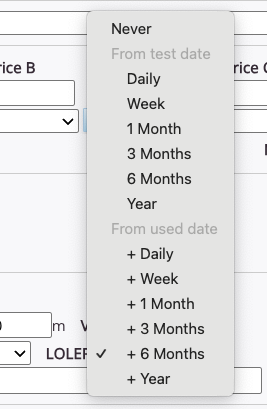
In your asset compliance types dropdown, you can now choose to set intervals either from the traditional test date, or use the new “From used date” setting.
Setting up your inspection intervals to trigger from the used date inside the compliance settings.
2. Inspect and store
When you complete a statutory inspection and place the asset back in storage, the expiry window displays an infinity symbol (∞). The item is officially logged as certified, safe and waiting.
Asset TEST3 sits safely in stock with its LOLER due date showing the infinity symbol, meaning the compliance clock is closed.
3. Scan and activate
The moment you scan that asset onto a job and it leaves the warehouse, the regulatory clock starts ticking (e.g., 6 months for lifting gear).
Once checked out on a job, the infinity symbol drops away and calculates the exact 6-month statutory deadline automatically.
This small change keeps you 100% compliant with global health and safety guidelines while maximising the usable, certified lifespan of your inventory.
Legal Compliance Across Different Jurisdictions
To see exactly how these automated HireHop tracking changes align with the statutory safety standards in your specific region, select your country’s framework below:
For lifting equipment (LOLER) and general work equipment (PUWER), the rules regarding “Thorough Examinations” are strictly governed by the Health and Safety Executive (HSE).
The Standard: HSE guidelines require that lifting equipment be thoroughly examined before it is put into service for the first time.
The Shelf Rule: If a piece of equipment comes with a valid Declaration of Conformity (usually valid for 12 months) and sits on your shelf unused, its statutory 6-month or 12-month countdown for its next inspection does not genuinely start until its Date of First Use.
For electrical equipment, the shift comes from the IET (Institution of Engineering and Technology) Code of Practice, 5th Edition.
The Standard: The 5th Edition moved away from the old “everything must be tested every 12 months” mentality in favour of a risk-based assessment approach.
The Shelf Rule: Under this guidance, if an item is tested, deemed safe, and stored safely in a dry warehouse, it isn’t degrading. The clock for its next recommended test interval doesn’t need to start ticking until it is put into service and exposed to the wear and tear of a rental environment.
For items like fall arrest harnesses, carabiners and hard hats, standards are set by manufacturers complying with BS EN standards, the EU PPE Regulation (EU 2016/425), and the Machinery Directive.
The Standard: The lifespan and testing intervals of this equipment are dictated by the manufacturer’s instructions.
The Shelf Rule: Materials like webbing and plastics degrade through UV exposure, sweat, and physical stress—not simply from existing on a shelf. Manufacturers now standardly state that their equipment has a lifespan (e.g., 5 years) running “from the date of first use,” provided it has been stored correctly in a dark, dry place.
In Australia and New Zealand, electrical testing is governed by the AS/NZS 3760 standard.
The Standard: When new electrical equipment is purchased from a reputable supplier, it doesn’t need to be immediately tested. Instead, it must be visually inspected and fitted with a tag stating its date of entry to service.
The Shelf Rule: The strictly mandated testing intervals — which can be as frequent as every 3 months for construction sites — only begin ticking from that date of first use.
In the US, OSHA sets the legal requirements but relies heavily on the American National Standards Institute (ANSI) for technical guidelines.
The Standard: For critical safety gear like fall protection harnesses, ANSI Z359 is the gold standard. In their technical bulletins, they explicitly refer to the Activation Date—the time when a product is first put into actual service.
The Shelf Rule: If a harness has a 5-year lifespan, ANSI guidelines generally allow that 5-year countdown to begin on the activation date, provided the item was kept in appropriate storage conditions prior to being issued.
Protecting Your ROI Without Sacrificing Safety
Whether it’s an “activation date,” a “date of entry to service,” or a “date of first use,” global standards recognise that equipment in proper storage is not deteriorating.
By utilising HireHop’s new “From Used Date” feature, rental operations can finally align their software with these regulations, maximising equipment ROI without sacrificing an ounce of safety or compliance.
We respect your privacy
We use necessary cookies to make the site work and, with your permission, preference, analytics and marketing cookies.