

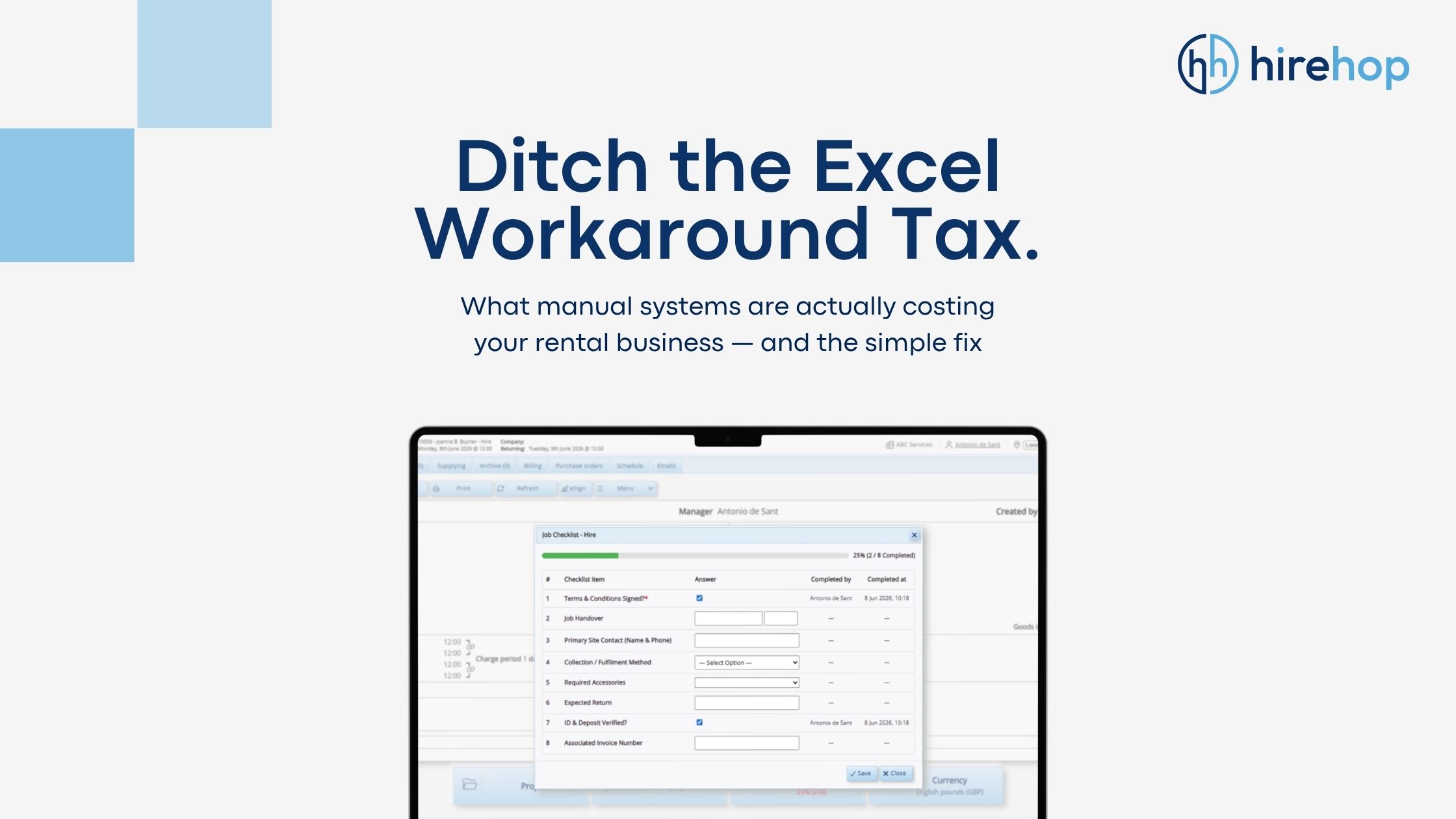
The “Excel Workaround” Tax: What Manual Systems Are Actually Costing Your Rental Business
Every hire shop starts on a spreadsheet. In the early days, it’s practical, free, and gets the job done.
But as your inventory grows and your team expands, that master spreadsheet starts depending on very specific human habits just to keep running smoothly. It usually belongs to one person on the hire desk who knows which cells not to touch, how the colour-coding works, and how to check if a key piece of kit is actually free for a big job next month.
Here’s the catch: while Excel doesn’t cost a penny on paper, the manual workarounds built around it carry a hidden price tag. They eat into your team’s time, create operational friction and slowly drain your profit margins without showing up as a line item on a balance sheet.
Here is what the “Excel Workaround Tax” actually looks like on the shop floor — and the true cost of paying it.
1. The “Single Point of Knowledge” Bottleneck
When equipment availability lives in someone’s head (or a highly customised personal spreadsheet), your entire operational desk slows down to the speed of a single person’s inbox.
If a client calls at 4:45 PM on a Friday asking for a last-minute kit swap and your lead planner has stepped away, the rest of the team is paralysed. Unable to trust the spreadsheet without checking with “the expert,” they’re forced to say: “Let me double-check with the warehouse and call you back on Monday.”
The Real Consequence: In the fast-moving event industry, “I’ll call you back” usually means the client calls a competitor who can confirm stock instantly. You don’t just lose that single booking; you risk losing the account entirely while piling unnecessary stress on a single staff member who can never truly take a day off.
2. The Sticky-Note Audit Trail
Spreadsheets are rigid: they don’t account for what actually happens on a loading bay floor. When a sub-hire arrives two days late, or a cable loom is swapped out at the last second, the system breaks down. To cope, the warehouse team creates informal workarounds: scribblings on printed job sheets, sticky notes stuck to monitors, or quick WhatsApp messages sent mid-prep.
The Real Consequence: Paper notes get lost, WhatsApp messages get buried, and accountability vanishes. When gear comes back damaged, missing or swapped, there’s no clear record of who handled it or where it went. You end up swallowing the cost of missing cables, unbilled repairs and lost flight cases simply because your paper trail dissolved between the warehouse floor and the hire desk.
3. The Unbilled Sub-Hire
When job prep, returns, and cross-hiring are logged across separate documents, the gap between what went out the door and what got invoiced widens dramatically. A sub-hired unit gets extended for an extra weekend at the client’s request, but because the change was noted on a clip-board rather than a live system, the final invoice goes out at the original price.
The Real Consequence: You end up paying the sub-hire supplier out of your own pocket while charging the client nothing for the extra days. It’s a direct hit to your profit margin on a job you’ve already delivered.
What If You Could Bridge the Gap?
Relying on spreadsheets and manual workarounds isn’t just frustrating: it actively caps your business growth and burns out your best staff.
Eventually, every growing hire business reaches a tipping point where they realise they need a dedicated equipment rental management system — a single, central platform designed specifically to track kit, build quotes and manage bookings without the chaos.
When you switch to a system built for the job, those bottlenecks simply disappear.
Imagine running your shop floor while the system quietly handles the heavy lifting in the background:
- The 4:45 PM Phone Call: Instead of searching through personal spreadsheets, anyone on the desk opens a live schedule. Equipment availability updates in real time as quotes are built. You confirm the stock on the spot, lock in the booking, and send a professional quote before hanging up the phone.
- The Loading Bay Return: Instead of scribbled paper notes, the warehouse team checks gear back in on a phone or tablet. Unexpected swaps, late returns or damaged items are flagged instantly at the point of check-in, creating an automatic, accurate audit trail without a single sticky note in sight.
- The Final Invoice: Instead of chasing prep sheets to see what actually went out, job changes and sub-hire extensions flow straight into your billing queue. When the job closes, the invoice is generated in two clicks, reflecting every extra day and swapped item accurately so your profit margins stay fully protected.
“OK, But Isn’t Changing Systems a Nightmare?”
Recognising that spreadsheets are holding you back is the easy part. The hesitation that comes next is completely understandable.
Moving away from a spreadsheet feels daunting because traditional equipment software has earned a bad reputation over the years. Too often, legacy systems come with months of tedious setup, rigid structures that don’t fit how a real hire shop operates, and overly complex menus that intimidate the crew on the floor.
It makes people think: “At least I know how my spreadsheet works.”
But modern rental management software shouldn’t feel like a second job.
Good software doesn’t force you to change your operational logic: it simply takes the manual friction out of it.
It should be intuitive enough for a new team member to pick up in an afternoon, flexible enough to handle sudden schedule changes on a Friday, and clear enough to give everyone the exact same picture of your business.
Upgrade Your Rental Business with HireHop
If you’re ready to retire the master spreadsheet and eliminate the workaround tax, HireHop is built for you.
We designed HireHop to be powerful enough for complex multi-depot operations, yet simple and intuitive enough for daily use on the shop floor. From automated quote-to-invoice workflows and live inventory tracking to seamless sub-hire management, HireHop gives you complete operational control, without the bloat or complexity.
Best of all, you’re never left to figure it out alone:
- Seamless Migration: We help you import your existing kit list and customer data cleanly so you’re not starting from scratch.
- Hands-On Support: Free, expert onboarding and ongoing support from specialists who actually understand the hire industry.
- Total Flexibility: A modern, cloud-based platform with no long-term contract lock-ins, so it scales effortlessly as you grow.
Contact our expert support team to book a quick, 1-on-1 demo today or try HireHop for free to see how effortless equipment rental management can be.