


Rigging Weight Loading Calculations for Multipoint Suspension of a Straight Truss
HireHop is probably the best and most feature-rich cloud-based equipment rental software, however it also has a resource for users to market their products for free to potential customers on HireHop’s equipment rental portal. As it has been a popular source for customers to source their hired rigging equipment, we decided to give some advice for when hiring motors and truss, as you need to know the rigging weight loading calculations involved.
The Imaginary Danger Scenario: Why 3 Motors Can Fail
Let’s take an imaginary scenario: a rigger has suspended a truss on its two end points. Each motor is rated at 500kg. However, the evenly distributed load on the truss is 1,300kg, so the rigger decides to attach a third 500kg-rated motor to pick up the centre of the truss.
Thinking that with three motors rated at 500kg each (1,500kg total capacity) there would be no problem, to his dismay, the truss comes crashing down—centre point first.
The reason this failed is due to multi-point beam load calculations that he failed to account for. The rigger incorrectly assumed that the three motors would share the weight equally and didn’t take into account the Three Moment Theorem.
While this is a highly complex mathematical formula, we can simplify the physics by breaking down the weight distribution as percentages of the entire load at each point:
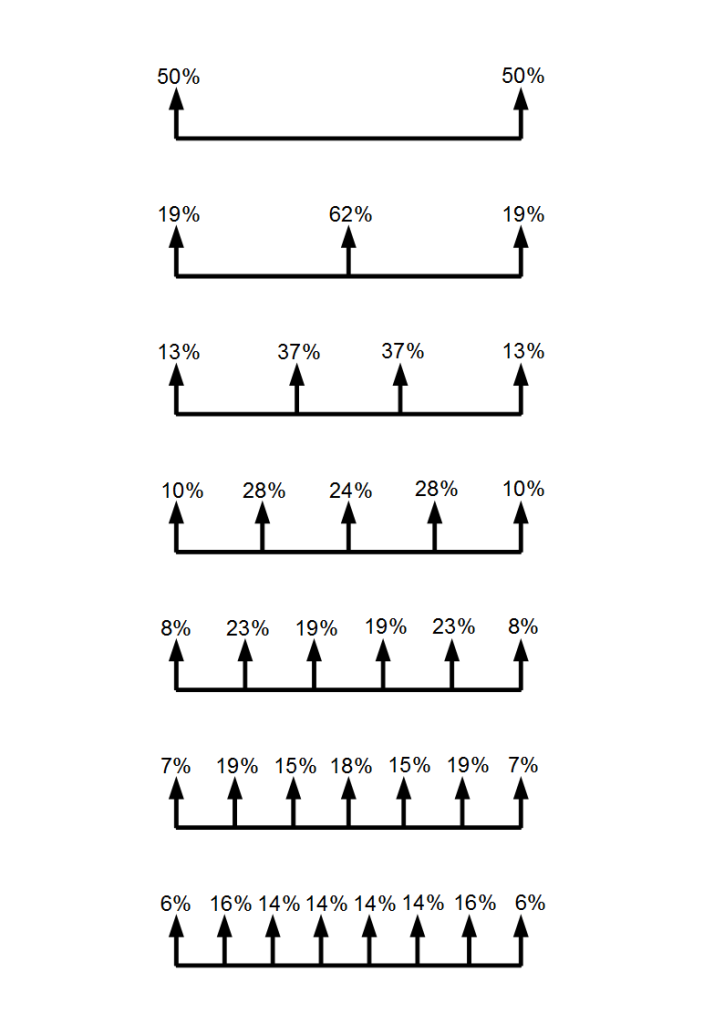
- 2-Point Pickup: Each point carries 50% of the load.
- 3-Point Pickup: The centre point supports 62% of the load, while the outer points only support 19% each.
You can also view an illustration of various simplified rigs below, including the various loads as percentages of the entire load at each point:
Breaking Down the Maths
Applying those exact distribution percentages to our imaginary rigger’s setup shows exactly why the system failed:
Total Load: 1,300kg
- Each Outer Point: 0.19 x 1,300 = 247kg per point (19% of the load)
- Centre Point: 0.62 x 1,300 = 806kg on the centre point (62% of the load)
As you can see, the 500kg-rated centre motor was heavily overloaded at 806kg, causing the structural collapse.
To fix this, the rigger should have introduced additional pickup points to balance the distribution:
Total Load: 1,300kg (Using a 4-Point Pickup)
- Each Outer Point: 0.13 x 1,300 = 169kg per point
- Centre Points: 0.37 x 1,300 = 481kg per point
Note: For this specific scenario, the rigger should ideally use a 5-point setup to give himself a larger safety margin, as a 4-point pickup only leaves a tight 19kg margin on the centre points.
⚠️ Important Safety & Real-World Factors
It is vital to note that these mathematical figures are theoretical and rely on an ideally balanced world. In the yard and on-site, multiple variables will alter these calculations:
- Even Distribution: These percentages only apply if the load is perfectly evenly distributed across the truss.
- Motor Speed Synchronisation: The calculations assume all hoist motors are moving at the exact same speed. On a 3-point pickup, if the centre motor moves faster than the outer two, it will take up 100% of the weight while the outer chains go slack.
- Manual Chain Blocks: It is highly advised not to rely on these percentages when using manual chain blocks, as they never climb at the same speed. For manual chain blocks, each individual block should technically be capable of supporting the entire load.
- Total Weight Factor: Always remember to include the physical weight of the truss itself and all attached fixtures when calculating your total load. If you are calculating the load on the points above the motor, remember to add the weight of the motor to each point.
Always include a healthy margin of error and never get too close to the maximum theoretical loading limits.
For more in-depth rigging calculations, please consult the Prolyte Black Book.