How We’re Improving Financial Visibility Across HireHop
As rental businesses grow, financial visibility tends to get more complex.
What starts as a relatively simple setup can quickly become harder to manage, with data spread across systems, reporting taking longer than it should, and more manual work creeping in behind the scenes. Over time, these issues make it harder to get a clear, reliable picture of what’s actually happening across the business.
We’ve been rolling out a number of updates aimed at improving this, giving you better visibility, more flexibility and more confidence in your financial data day to day.
Here’s what’s new at HireHop 👇
Table of contents
- Better financial reporting and analysis
- More automated financial workflows
- Improved accuracy and compliance
- More flexible pricing and trading structures
Better financial reporting and analysis
As businesses grow, reporting needs tend to become more detailed.
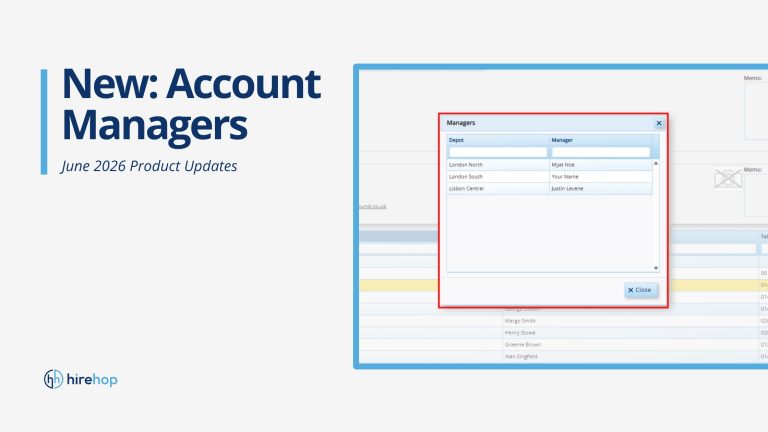
It’s not just about overall numbers anymore, but about understanding performance across different parts of the business, whether that’s departments, depots, or specific types of work.
1. Departments and tracking categories integration
We’ve added support for departments and tracking categories within accounting integrations that support them.
These now sync directly from your accounting software and can be applied at a transaction level within HireHop. That means each transaction can be assigned to a specific department, which then flows through to your accounting package.
In practice, this gives you an additional layer of analysis on top of nominal codes, making it much easier to break down performance across different areas of the business.
2. Microsoft Dynamics 365 Business Central integration
We’ve also introduced an integration with Microsoft Dynamics 365 Business Central, which is widely used by larger organisations.
This was an important addition for businesses operating at scale, particularly those already relying on Business Central for financial management. It allows HireHop to fit more seamlessly into existing systems, without needing workarounds or duplicate processes.
Read more about this exciting new feature in this dedicated article.
More automated financial flows
One of the biggest challenges in financial operations is the amount of manual work involved in keeping everything moving. Small inefficiencies can quickly add up, especially when invoices, payments and approvals all rely on multiple steps or teams.
Stripe payments on pro forma invoices
We’ve introduced the ability to take payment via Stripe on an unauthorised (pro forma) invoice, and automatically create and approve the invoice once payment is received.
Before, the process often looked like this:
- A manager sends a pro forma invoice
- The customer pays manually
- The manager checks with finance to confirm payment
- The job is then confirmed in HireHop
Now:
- The manager sends a pro forma with a Stripe payment link
- The customer pays instantly by card
- HireHop automatically logs the payment
- The accounting software is updated
- The invoice is authorised
- The job status can be updated to “Booked”
It removes several manual steps and speeds up the entire process.
Improved accuracy and compliance
As financial data becomes more important to decision-making, accuracy and compliance become increasingly critical.
1. Improved depreciation aligned with accounting standards
We’ve enhanced depreciation functionality to support multiple recognised methods, including:
- Straight line
- Sum of the years
- Declining balance
These calculate depreciation in different ways depending on how assets are used.
All of this is captured in an updated fixed assets depreciation report, showing:
- Real-time depreciation
- Depreciation over a selected period
- Disposals
- Profit or loss on assets
For finance teams, this means more accurate reporting directly within HireHop, without needing to rely on external calculations.
2. eInvoice download functionality
We’ve introduced a downloadable eInvoice feature.
While this isn’t currently required in the UK, it’s already mandatory in parts of the EU, and the UK appears to be moving in that direction.
This makes it easier for businesses operating internationally (or planning ahead) to stay compliant as requirements evolve.
More flexible pricing and trading structures
As businesses grow, pricing and trading structures often become more complex, and what works for a smaller operation doesn’t always scale.
Unlimited price groups with depot-level control
You can now create unlimited price groups, with the ability to assign them to specific depots.
This gives you much more flexibility in how pricing is structured.
For example, some businesses quote several years in advance and need to plan pricing ahead of time with percentage increases built in. Others may need different pricing tiers depending on customer type.
This update allows you to set that up in a way that fits your business, rather than working around system limitations.
Bringing it all together
Individually, these updates each solve a specific problem; but together, they’re designed to reduce manual work, improve accuracy and give you a clearer, more reliable view of your financial data.
That means less time managing processes, and more confidence in the numbers you’re working with day to day.
Final thoughts
Financial visibility isn’t just about having access to data: it’s about being able to trust it, understand it and use it to make decisions quickly.
As businesses grow, that becomes harder, but with the right structure in place, it doesn’t have to.
If you’d like to see how these updates work in practice, or how they could apply to your setup, we’re always happy to talk things through. Click here to contact our friendly support team or request a demo now.